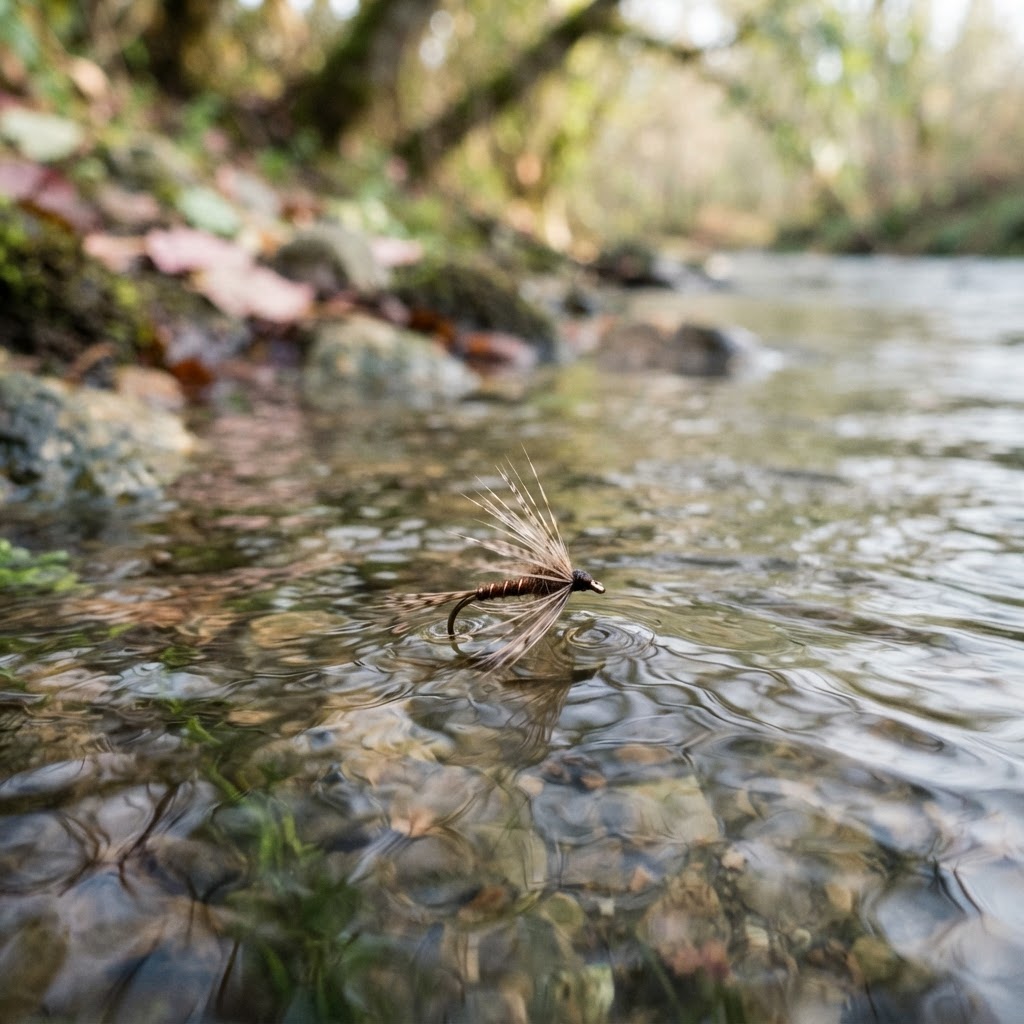
The soft hackle is older than the reel on your rod. It is a fly that was already old when the Civil War ended, and it has been catching fish through every season since for one simple reason: it looks, in the water, exactly like the thing the fish are eating.
A soft hackle has a body, a little thorax, and a feather tied in so the barbs sweep back over the hook bend. That's it. There is no wing to align, no tail to split, no epoxy to cure. When you swing it across and downstream, the current pushes the hackle back and the fly breathes, opens and closes, opens and closes, and a trout sees an emerging insect struggling toward the surface. That is a thing a trout has been eating since before trout had a name.
It's the only fly I carry that I trust more the worse I tie it.
How to fish it
Cast across and slightly downstream, throw an upstream mend, and let the fly swing until it hangs straight below you. The take almost always comes on the swing, a sharp, electric pull, not the sipping rise of a dry-fly eat. Let it hang for a second at the end of the swing before you pick up. Half the fish come on the dangle.
Fish it shallow first, in the riffle tops and the soft water at the heads of pools. Then move deeper. A soft hackle fished on a tight line through a riffle will out-fish a nymph rig in the same water more often than it has any right to.

